How to Write a Statement of Purpose (SOP) in 6 Steps
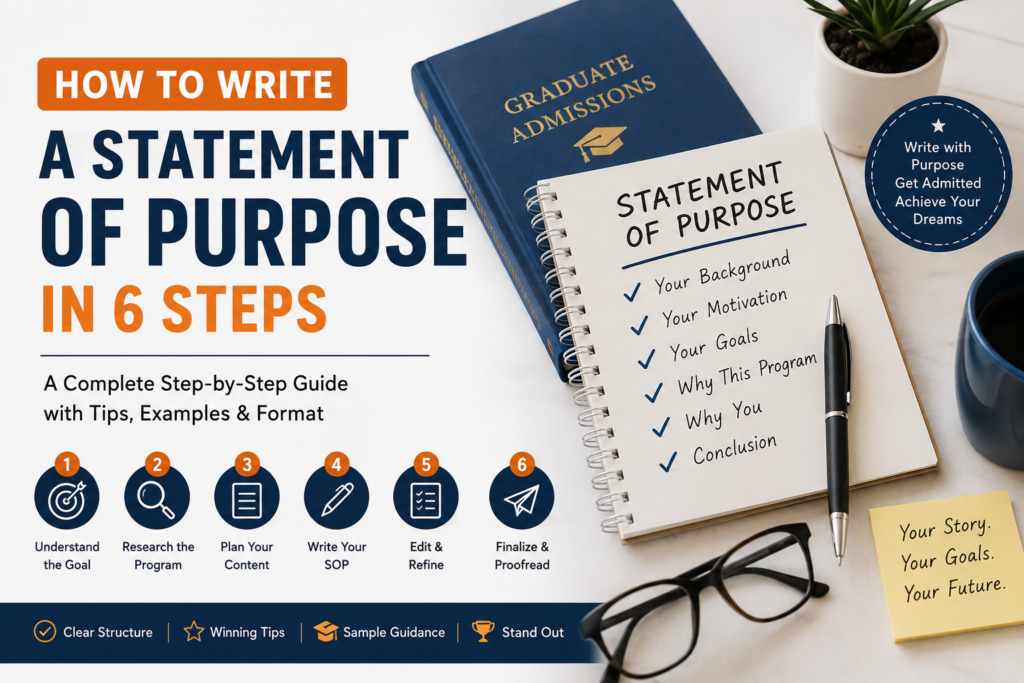
Writing a Statement of Purpose starts with understanding your program’s specific requirements, then identifying which parts of your academic and professional background are actually relevant, explaining why you chose that field and that institution, connecting your past experience to clear future goals, and finally editing until the draft sounds like you rather than a template. The strongest SOPs are specific, not impressive-sounding – they show an admissions committee exactly why this applicant, this program, and this moment fit together.
Every application cycle, admissions committees read through hundreds of SOPs that sound almost identical – the same opening about lifelong passion, the same closing about contributing to the field. Somewhere in that stack, a handful of statements stand out, and it’s rarely because the applicant achieved more. It’s usually because they understood what an SOP is actually meant to do: connect a real, specific background to a real, specific program.
This guide walks through six practical steps for writing an SOP that does that, along with a simple framework you can use to test your own draft, a breakdown of common mistakes, and answers to the questions applicants ask most often. Requirements vary by university, program, and country, so treat this as a working process to adapt – not a template to copy word for word.
What Is a Statement of Purpose?
A Statement of Purpose is a written document, usually 500 to 1,500 words depending on the program, that explains your academic background, your reasons for applying to a specific course, and your future goals. Admissions committees – and in some cases visa officers – read it to understand the person behind the transcripts and test scores: why this field, why this program, and what you intend to do with the opportunity.
An SOP is not a restatement of your resume. A resume lists what you’ve done; an SOP explains why those experiences matter and how they connect to what you’re applying for next. Two applicants can have nearly identical resumes and write completely different SOPs, because the SOP’s job is to show reasoning and direction, not just achievement.
How to Write a Statement of Purpose in 6 Steps
The process below breaks SOP writing into six manageable stages. Each one builds on the last, so it’s worth working through them in order rather than jumping straight to drafting.
Step 1 - Understand the University and Program Requirements
Before writing a single sentence, find your program’s actual SOP instructions – most universities publish these on the admissions or application portal. Look specifically for:
- Required questions or prompts (some programs ask direct questions instead of a general “statement of purpose”)
- Word or character limits
- Required topics the program specifically wants addressed
- Formatting instructions (font, spacing, file format)
- Whether the SOP is submitted separately from a personal statement or combined with one
Requirements genuinely vary – one program’s SOP might cap at 500 words and ask three specific questions, while another wants an open 1,000-word narrative. Writing a strong SOP against the wrong requirements is a common, avoidable mistake, so this step is worth doing properly before anything else.
Step 2 - Map Your Academic and Professional Background
List out everything potentially relevant: your academic history, coursework, projects, research experience, internships, employment, certifications, and specific skills or achievements. At this stage, write down more than you’ll use – the goal is a complete inventory to select from.
Then go back through that list and ask, for each item, whether it builds your case for why you belong in this specific program. An achievement that’s impressive but unrelated to your field usually doesn’t earn space in an SOP that’s already fighting a tight word limit. Applicants who struggle with SOPs often default to listing everything chronologically, the way a resume does – but an SOP is selective by design. Prioritizing three or four genuinely relevant experiences, explained well, is almost always stronger than eight experiences mentioned briefly.
Step 3 - Explain Why You Chose the Course and Field
This is where a lot of SOPs default to generic language. A version of “I have always been passionate about this field” is one of the most common opening lines admissions committees read, and it tells them nothing about the applicant specifically.
A stronger approach connects four things in sequence: a past experience, the interest it created, the academic gap that interest revealed, and the program that fills it. For example, instead of claiming lifelong passion for data science, an applicant might describe a specific project during their undergraduate degree where they hit the limits of their statistical knowledge, what that made them curious about, and how a particular program’s coursework in that exact area addresses it. The claim becomes specific and traceable rather than a general statement anyone could make.
Step 4 - Show Why This University or Program Fits You
This is often the weakest section in SOPs that are otherwise well written, mostly because applicants under-research it. Saying a university has “an excellent reputation” in this field is true of dozens of programs and demonstrates nothing about genuine interest.
A stronger university-fit argument names something specific: a course in the curriculum that directly supports your goals, a research area or lab you’d want to be part of, a specialization track, or a particular strength in the program that’s genuinely relevant to your background. This requires actually reading the program page, not just the university’s general reputation – but it’s usually the single highest-leverage section to get right, because it’s the clearest signal to a reader that you’ve done real research rather than applying broadly to a list of “good schools.”
Step 5 - Explain Your Career or Research Goals
This section connects your background and the proposed program to what comes next. It works best structured in three parts: your current background, what you’ll gain from this specific program, and what you plan to do with it — split into a short-term goal (the next few years) and a longer-term direction.
The difference between a vague goal and a credible one usually comes down to specificity. Wanting to “make an impact in the tech industry” could be written by almost any applicant. Wanting to work on machine learning applications in healthcare diagnostics, building on the research methods developed in a program’s applied ML specialization, is specific enough that a reader can actually evaluate whether the program supports it. For a Master’s applicant, this section often focuses on a defined next career step. For an MBA applicant, it typically connects prior professional experience to a leadership or industry transition. For a PhD applicant, it should point toward a genuine research direction rather than a job title.
Step 6 - Edit, Personalize and Finalize Your SOP
A first draft is rarely a final draft. In this stage, review specifically for:
- Logical flow – does each paragraph build on the one before it?
- Grammar and clarity – is every sentence doing real work?
- Consistency – do the goals in your conclusion match the motivation in your opening?
- Personalization – could this paragraph have been written by another applicant, or is it clearly yours?
- Program relevance – does every section still connect back to the specific university and course?
- Word limits and formatting – does it match exactly what the program asked for?
The most useful final check is a simple one: read the SOP and ask whether it sounds like you, describing your actual experiences and goals, or like a template with your name inserted. Admissions readers see thousands of SOPs – the ones that read as authentic, specific, and personally voiced are the ones that get remembered.
The 5-Question SOP Test
Once you have a full draft, a simple way to stress-test it is to check whether it clearly answers five questions:
- Why this field? Your motivation, grounded in specific experience.
- What have you done to prepare for it? Your relevant academic and professional background.
- Why this specific course? Not the university’s general reputation, but what the program itself offers you.
- Why this university? Something concrete: faculty, research, curriculum, or resources unique to that institution.
- What do you plan to do after the program? A goal specific enough that a reader could evaluate whether it’s realistic.
If your draft can’t answer one of these clearly and specifically, that’s usually the section to revise next.
What Should an SOP Include?
Requirements vary by program, but most SOPs cover the same general sections. The table below is a practical starting framework – adapt it to your program’s actual instructions rather than treating it as fixed.
| Section | What to Explain | Common Mistake |
|---|---|---|
| Introduction / Motivation | What draws you to this field, grounded in a specific experience | Opening with a generic statement about passion |
| Academic Background | Relevant coursework, projects, and preparation | Listing every course instead of the relevant ones |
| Relevant Experience | Internships, research, or work that supports your application | Including experience with no clear connection to the program |
| Course/Program Motivation | Why this specific program, not just the field generally | Vague reasoning that could apply to any program |
| University Fit | Specific curriculum, faculty, or research relevant to you | Praising the university's reputation without specifics |
| Career/Research Goals | Short-term and long-term direction | Vague ambitions with no connection to the program |
| Conclusion | A clear, confident close that reinforces your fit | Repeating the introduction almost word for word |
A Quick Example: Weak vs. Stronger SOP Opening
The difference between a forgettable SOP and a strong one often shows up in the very first lines. Here’s an illustrative example (not a real applicant) showing the same underlying story told two different ways.
Weak version: “Since childhood, I have always been passionate about technology and its power to change the world. I am a hardworking and dedicated student who is eager to pursue a Master’s degree in Computer Science.”
Better version: “During a final-year project building a recommendation system for a local retailer, I spent three weeks stuck on a problem that came down to a gap in my understanding of statistical modeling -not programming. That specific gap is what led me to look for a Master’s program built around applied machine learning rather than general computer science.”
Notice the difference isn’t tone or vocabulary – it’s specificity. The second version gives the reader something concrete to evaluate; the first could be submitted by almost any applicant to almost any program.
10 Common Statement of Purpose Mistakes to Avoid
- Generic introductions – opening with a broad statement about passion rather than a specific detail.
- Repeating the resume – listing achievements chronologically instead of explaining their relevance.
- Praising the university without research – vague reputation-based claims instead of specific program details.
- Vague career goals – ambitions general enough to apply to any applicant.
- Listing achievements without context – mentioning an accomplishment without explaining why it matters here.
- Leaning on clichés – phrases like “since childhood” or “I have always dreamed of.”
- Copying SOP samples or templates – a strong SOP is noticeably specific to one applicant; borrowed structure often shows.
- Writing one SOP for every university – reusing the same draft without adjusting the program-fit section.
- Ignoring the official prompt – answering a generic “why this program” question instead of the specific one the university asked.
- Skipping a real edit – submitting a first draft without checking flow, consistency, and word limits.
How SOPs Differ for Master's, MBA and PhD Applications
While the core structure above applies broadly, what you emphasize shifts depending on the type of program.
| Application | What to Emphasize |
|---|---|
| Master's | Academic preparation, subject-specific interest, program fit, and a defined next career step |
| MBA | Professional experience, leadership examples, career progression, and clear post-MBA goals |
| PhD | Research interests, research preparation, fit with faculty/research areas, and a credible potential research direction |
These are general tendencies rather than fixed rules – always follow your specific program’s instructions over general guidance like this.
SOP Expectations Across Countries - What Generally Differs
Because SOP requirements aren’t standardized globally, expectations can vary meaningfully by country and institution, at a high level:
- USA programs often expect a strong emphasis on research fit and specific faculty or lab interests, particularly for graduate and PhD applications.
- UK institutions sometimes use the term “personal statement” rather than SOP, especially for undergraduate applications, with somewhat different conventions (see the comparison below).
- Canada frequently requires SOPs for both academic admission and, separately, for study permit (visa) applications – these serve different purposes and are usually not interchangeable.
- Australia commonly expects SOPs for both university admission and student visa applications, with visa-related SOPs needing to address genuine temporary entrant requirements specifically.
These are general patterns, not universal rules – individual universities and departments set their own specific requirements, so always confirm directly against your program’s official application instructions rather than assuming a country-wide standard.
SOP vs. Personal Statement: What's the Difference?
The terms “Statement of Purpose” and “personal statement” are sometimes used interchangeably, and sometimes to mean genuinely different documents – the distinction depends on the institution.
In general usage, an SOP tends to focus more narrowly on academic and professional motivation: why this field, this program, and these goals. A personal statement, particularly in UK undergraduate applications, often allows more space for personal background, character, and broader life experience alongside academic interest.
If your application asks for a personal statement rather than an SOP, check whether the institution’s own instructions clarify what they expect – the same document type can carry different expectations at different universities.
SOP Pre-Writing Checklist
Before you start drafting, it helps to have the following gathered:
- Your program’s specific SOP requirements and word/character limit
- Your academic history and relevant coursework
- Details of any relevant projects or research
- Work or internship experience worth including
- Your short-term and long-term career or research goals
- Specific reasons for choosing this program (curriculum, faculty, research areas)
- Specific reasons for choosing this university
- Achievements or examples that support the above points
Having this laid out before you start writing makes the actual drafting faster and keeps the final SOP focused on what’s genuinely relevant.
Final Thoughts
tionA strong Statement of Purpose isn’t the one with the most impressive achievements – it’s the one that most clearly connects a real background to a specific program and a credible future. Working through the six steps above, testing your draft against the five questions, and editing until it sounds like you rather than a template will put you ahead of a large share of the SOPs an admissions committee reads.
Writing an SOP becomes much easier once you know what admissions teams are actually looking for – and even applicants who understand the process well sometimes want a second, experienced perspective before submitting. If you already have your background and goals mapped out but want help structuring, tightening, or refining the final draft, Galaxy DigiMart’s SOP writing team works directly from your academic profile and goals to help the SOP communicate as clearly as it should, catering you academic writing services.
FAQ
A Statement of Purpose is a written document submitted as part of an application, typically 500 to 1,500 words, explaining your academic background, motivation for choosing a specific program, and future goals. Admissions committees use it to understand your reasoning for applying - not just your qualifications - and to assess whether your goals genuinely align with what the program offers.
Start by reviewing your program's specific SOP requirements, then identify a concrete experience that explains your interest in the field, rather than opening with a general statement about passion. A strong opening connects a real moment or project to the reason you're pursuing this specific program, giving the reader something specific rather than something generic.
Most SOPs cover your motivation for the field, relevant academic and professional background, reasons for choosing the specific program and university, and your career or research goals. The exact sections and emphasis should follow your program's official instructions, since requirements vary by university and degree level.
SOP length depends entirely on the university and program - some specify an exact word or character limit, while others give a general range, often between 500 and 1,500 words. Always check your specific application's official instructions rather than assuming a standard length, since submitting the wrong length can affect how your application is reviewed.
Not effectively. While your core background and goals stay the same, the university-fit section needs to reference specific details about each program - curriculum, faculty, or research areas - that don't transfer between applications. Reusing an SOP without adjusting this section is one of the most common reasons SOPs read as generic.
The terms are sometimes used interchangeably, but where they differ, an SOP typically focuses more narrowly on academic and professional motivation, while a personal statement - especially for UK undergraduate applications - often allows more space for personal background and character. Since usage varies by institution, check what your specific program expects.
Yes, most SOPs are expected to address both short-term and long-term goals, since this helps admissions committees assess whether the program genuinely fits your direction. Goals are strongest when they're specific enough to be evaluated - a general ambition like "making an impact" is harder to assess than a defined next step.
Yes - many applicants work with an experienced writer or editor once they've mapped out their own background and goals, particularly to strengthen structure, clarity, and university-fit sections. Professional SOP support typically works from the applicant's real information rather than generic templates, since a credible SOP needs to reflect the applicant's actual profile.